My stay in Korea last year encompassed many firsts in my life – flying alone, living independently of my family, solo travelling… and autumn. My first genuine autumn after 21 years of stale summer in Singapore. It was the season where I never felt like staying indoors, the season where everything seemed to have a sentimental value to it, the season where memories of rough summer days were awashed by freshness.
In this post I’m sharing a few spots where I saw some unforgettable scenes of fall foliage in Seoul. I’ve actually picked and edited the photos in this post eons ago, but I missed the timing to write it, and eventually resorted to waiting close to a year to get this up. The best time for sight-seeing of foliage in Seoul is from the last week of October to the first week of November!
1. Haneul Park

Nearest train station: World Cup Stadium
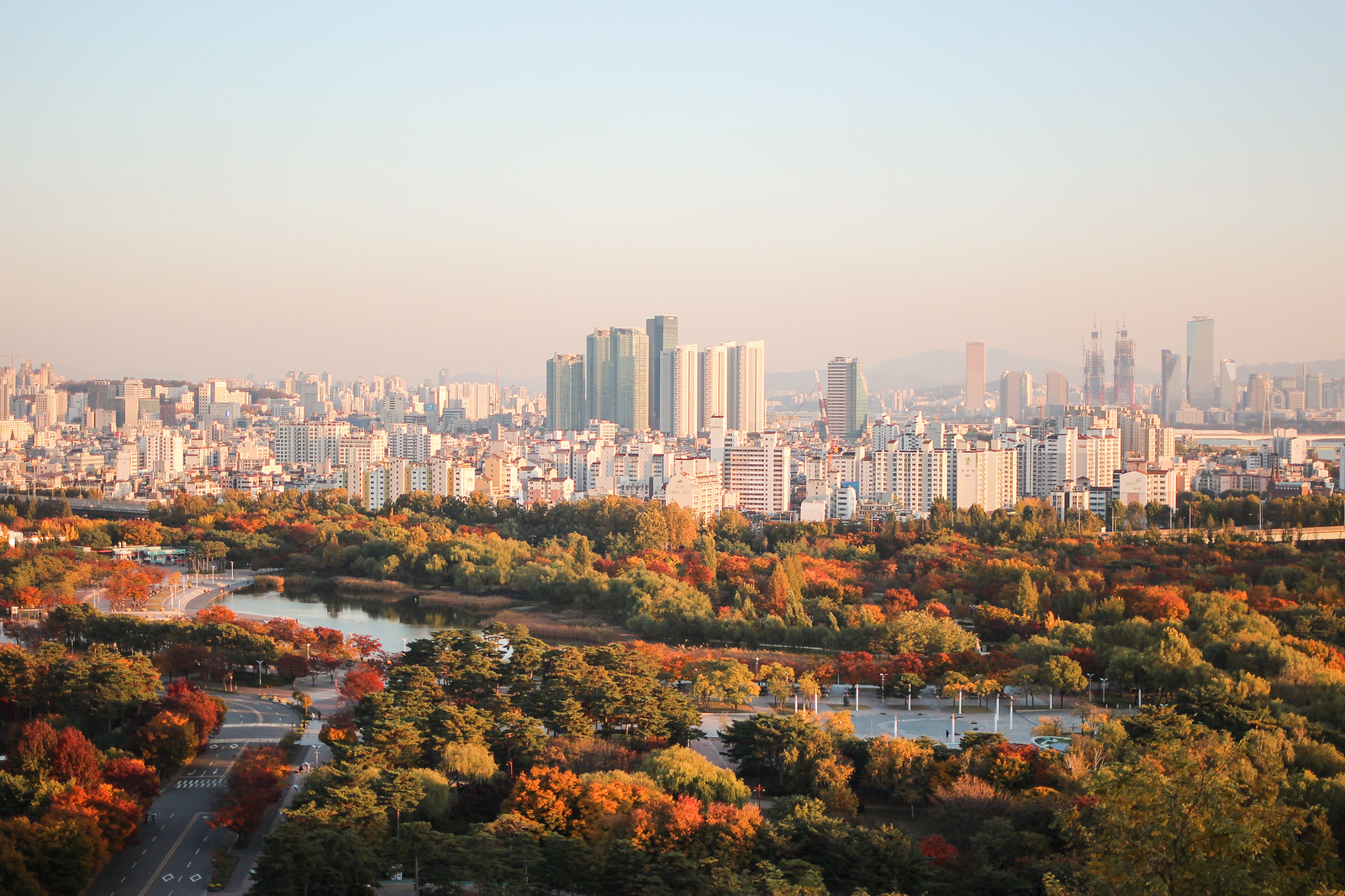
One of the 5 parks of the World Cup Park, Haneul directly translates to ‘Sky’, it’s name befitting of its location on the highest part of the World Cup Park on a hill. To get up, you can either pay a small fee for a tram or climb up 291 steps of stairs. I recommend the latter for the views on the way up, and also since the weather will not make you break out in a sweat.


I can’t remember how I first came to know about this park, but when my first time there was actually in the transition phase of Spring to Summer. During that time, the park was not crowded in the slightest bit and filled with mostly green plants, with occasional splashes of colours from planted flowers. Visiting again but in autumn was a different thing altogether – throngs of people (both locals and tourists) and the rich luscious colours of fall created a lovely bustling atmosphere.


The two most representative plants at the park in autumn are the silver grass and pink muhly grass – though you may find them at spots all over Korea, the fields at Haneul Park are expansively planted with them and divided into specific zones. The best time to go would be at sunset, when the park is tinged with soft, golden light.
2. Campus Tour – Yonsei University


Nearest train station: Sinchon
Having attended Yonsei University for a short semester, I’ve seen the transition from late summer green to autumn yellow, orange and red like a time-lapse video. The day-to-day anticipation was fluttering, and slightly kept me energised for lessons even.
Most people know about the main pedestrian path of the school that starts from the main gate and that leads right all the way in to the heart of the school – in autumn, the gingko trees that neatly line this main road turn yellow. However, I preferred the foliage found deep in the remainder of the school – the gingko trees are larger and more densely grown with leaves and more fall colours can be spotted. I snapped these two photos on an uphill road that serves as a side entrance to the school.
3. Seoul Forest


Nearest train station: Seoul Forest
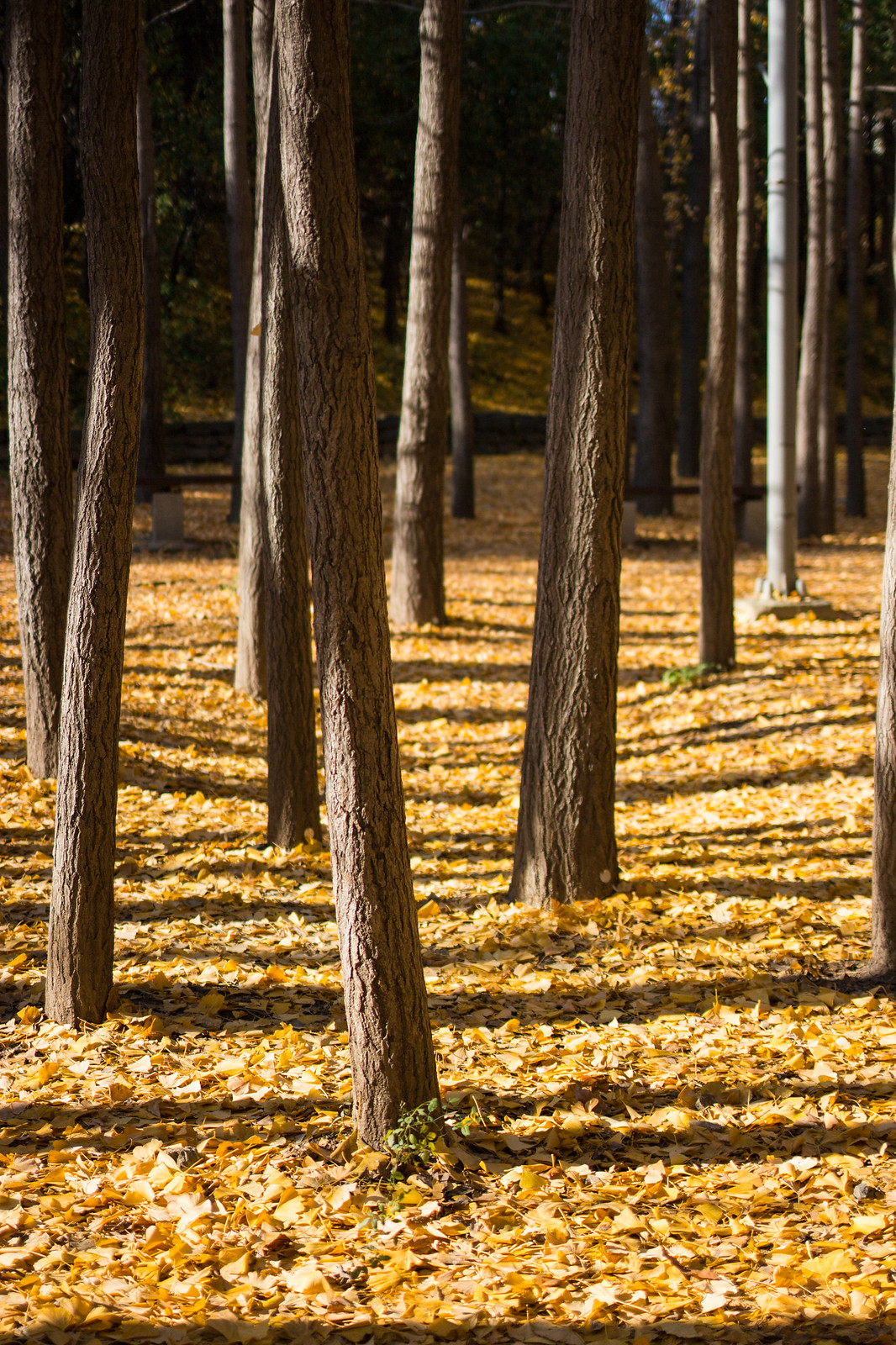
When I finally had the time to go to Seoul Forest with my camera, the weather had become much chillier (necessitating a winter jacket) and the season was about to come to its end. While thinking to myself if I had made the wrong choice in making a futile journey, I chanced upon a vast field of yellow fallen leaves. Bare trees grew interspersedly, while the afternoon sun cast their long shadows cast all across the field of yellow, creating a brilliant canvas. I spent a good amount of time there, before moving on and picking out the remaining trees in autumn bloom. A good number of maple trees were still bearing red crowns, thankfully.
P.S. Along Seoulsup-gil which is just right outside the park, there is a small cafe district that I feel is worth heading to after a stroll in the park.
4. Seodaemun Independence Park


Nearest train station: Dongnimmun
The fall foliage at this park was an unexpected and surprising find. I alighted at Dongnimmun Station in hopes of finding the path through Ansan Park that would lead me up to Ansan Mountain, but didn’t manage to do so.


Instead, I found myself at Seodaemun Independence Park (did not even know the name of the park at that time), an important historic cultural site serving as a remembrance of Korean liberation activists during the Japanese colonial period. It is also the grounds of the Seodaemun Prison History Hall and Museum which was used to hold Korean independence fighters captive.


Several other monuments were erected in the park, and there were also many spaces provided for recreational and family activities. The historical site, together with the background of lush foliage in varying colours, created a grandiose sight.
5. Gyeongbokgung


Nearest Station: Gyeongbokgung
Oh, the classic spot that I just couldn’t leave out of this post, no matter how well-known it already is. There are many spots to admire the fall foliage in the Gyeongbokgung premises and the surrounding neighborhoods, but one of my favorites is that along Hyoja-ro. Running along the West Wall of the Gyeongbokgung Palace, the road is methodically planted with gingko trees which turn bright yellow in autumn, and runs through a few neighborhoods like Hyoja-dong, Changseong-dong and Tongui-dong. Compared to the grounds of the palace and the very touristy neighborhoods on the East of the palace (where Bukchon and Samcheong-dong are), the West side is less crowded (with the exception of Tosokchon Samgyetang) and allows you to take in the foliage in a more tranquil manner.
On the other side of Hyoja-ro, you can expect to find small museums, galleries and cafes, from which you can get a view of the foliage too.




 메이플라떼는 메이플시럽이 들어가 있었기 땜에 커피가 달달하고 커피 맛 안 셌다.
 옆에 있었던 두 테이블의 여자분들이 나와 같은 토스트를 시켰는데 동시에 서서 토스트 사진 찍는 게 너무 웃기더라. 아마 반투명한 커튼으로 비쳐 들어온 그 날의 햇빛이 예뻐서 더 열심히 찍었던 것 같다.


 After a quick brunch at a café in the Haeundae district of Busan, I had planned to have dessert at Bibibidang, which happens to be located in a building nearby on the same road (Dalmaji-gil). It turns out that the entire building is managed by the same brand, with each level showcasing a different concept.
 Bibibidang, occupying the 4th floor of the building, is a traditional Korean tea house and dessert café that had opened its doors since 2012. Till today, it retains its popularity much thanks to the amazing view overlooking the East Sea from the café itself.
 The name of the café has origins that are as interesting as its name sounds. In Buddhist cosmology, there exist 3 realms in which the highest point of attainment is termed 非想非非想天(bi-sang-bi-bi-sang-cheon in Korean romanization). This point is where all desires are overcome and is also said to be the equivalent of enlightenment. Thus, Bibibidang (a direct translation to Chinese would be 非非非堂), represents a space where one can dream of transcending that point.

 However, instead of tea, I went for a popular dessert on the menu, the Sweet Pumpkin Bingsu (10,000KRW). Meant for 1 person’s portion, the bingsu was plated delicately on a wooden tray, together with small piece of tea confectionery (called dashik) on the side. Unlike any of the bingsus I’ve had, the top layer was slathered generously with sweet sauce, giving a sticky consistency. The shaved ice, a pure bright natural pumpkin orange, contained real chunks of pumpkin within, giving a rich and intense flavor.
 Another popular item on the menu is the Red Bean Porridge (8000KRW), perfect as a warm treat in winter.
 Very much reluctant to leave the serenity of the café, I stayed for as long as my self-planned itinerary would permit. Perhaps one of the most peaceful time I’ve spent in a café.

 I’ve long heard of both cafes Choryang 1941 and Choryang 845 – the former being the first established outpost and the latter a new business concept and expansion by the same folks.
 Despite being on a hill in a less accessible district, getting there was fuss-free since there were direct buses running to and from Busan subway station and Choryang subway station, with not much walking required.


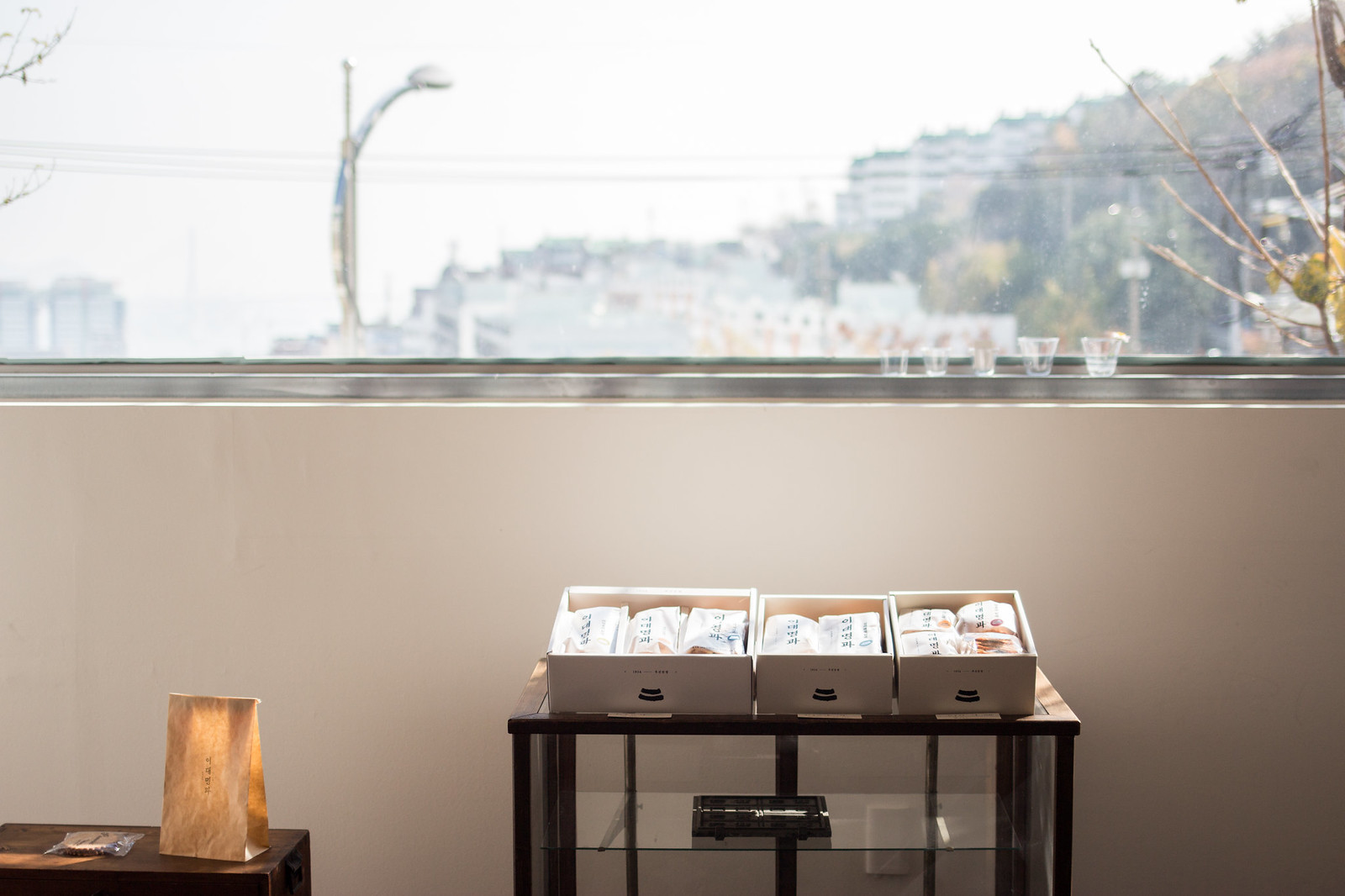 Amazing light and shadows in this biscuit store. Got some sesame crackers back.

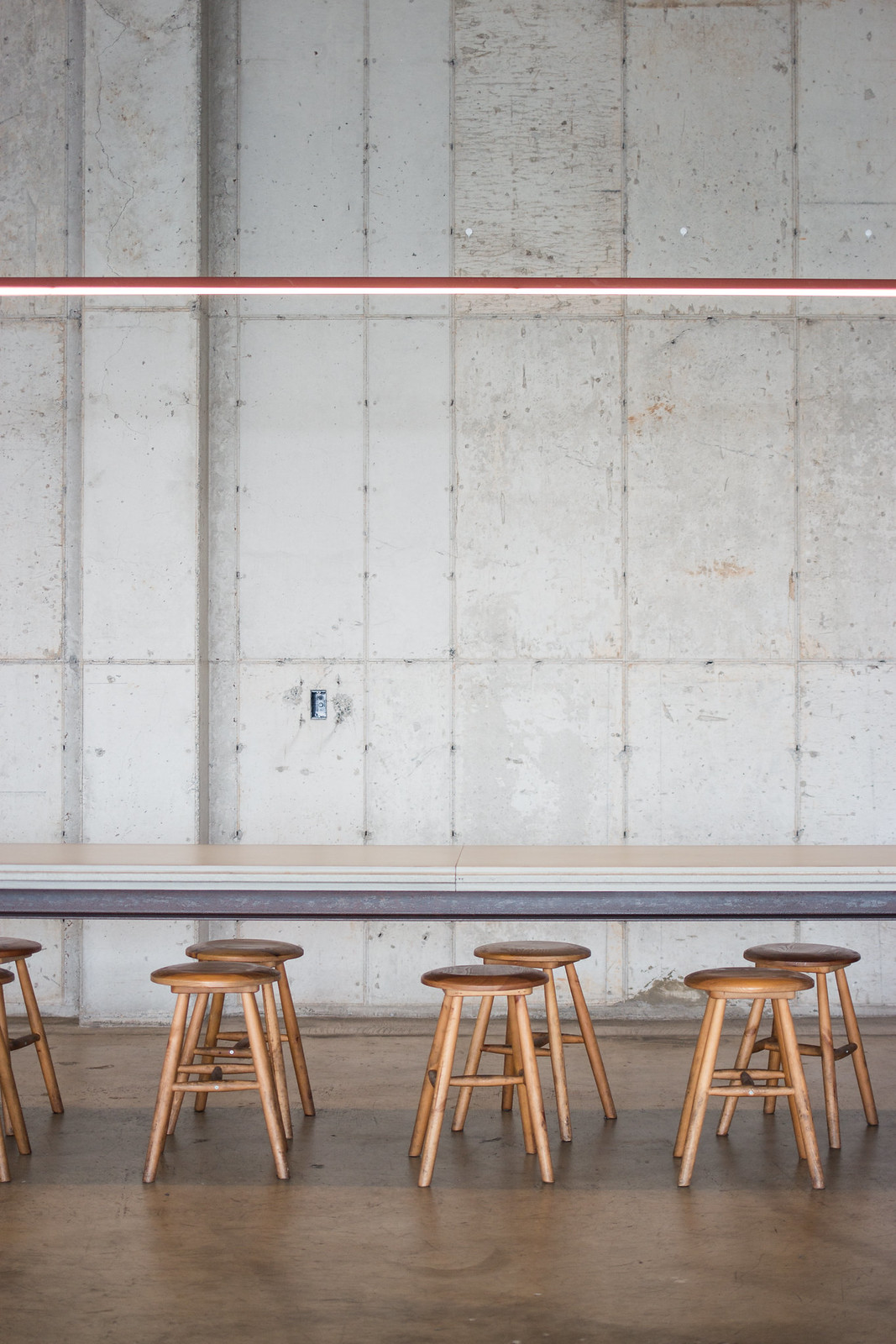
 I immediately picked a table right by the extensive glass windows. On that clear sunny day with no traces of micro dust in the air, the view overlooking the residential neighborhood of Choryang was comforting.
 There were separate sites for ordering food and drinks (+pastries). I ordered the Yuzu Hibiscus Tea (7,000KRW) from the barista by the coffee machine and it came in two pretty layers of red and yellow; I ordered the Korean Set Lunch (13,000KRW) that comes with rice and a variety of side dishes from the counter right in front of the kitchen.
 When I was there, I didn’t have time to look up what I was eating so I only recently looked them up again and translated them to English. Looking back at this list, I was reminded of how clean and healthy each dish tasted and how the entire set came together as a wholesome meal. My kind of comfort food for the soul.


 845-1 Choryang-dong, Dong-gu, Busan, South Korea

 This short trip to the coastal city of Gangwon-do was an impromptu decision made just a week in advance, and it was really impromptu for someone like me who likes to have ample time to plan trips ahead.
 We arrived at night in a city, oddly quiet right from the radius of the KTX station itself. The walk to our AirBnB apartment (

 Early in the morning, we headed out to our furthest destination on our roughly planned itinerary – Jumunjin Beach. From Gangneung KTX station, the ride by a public bus took about 45mins and we arrived at a near empty beach that morning.
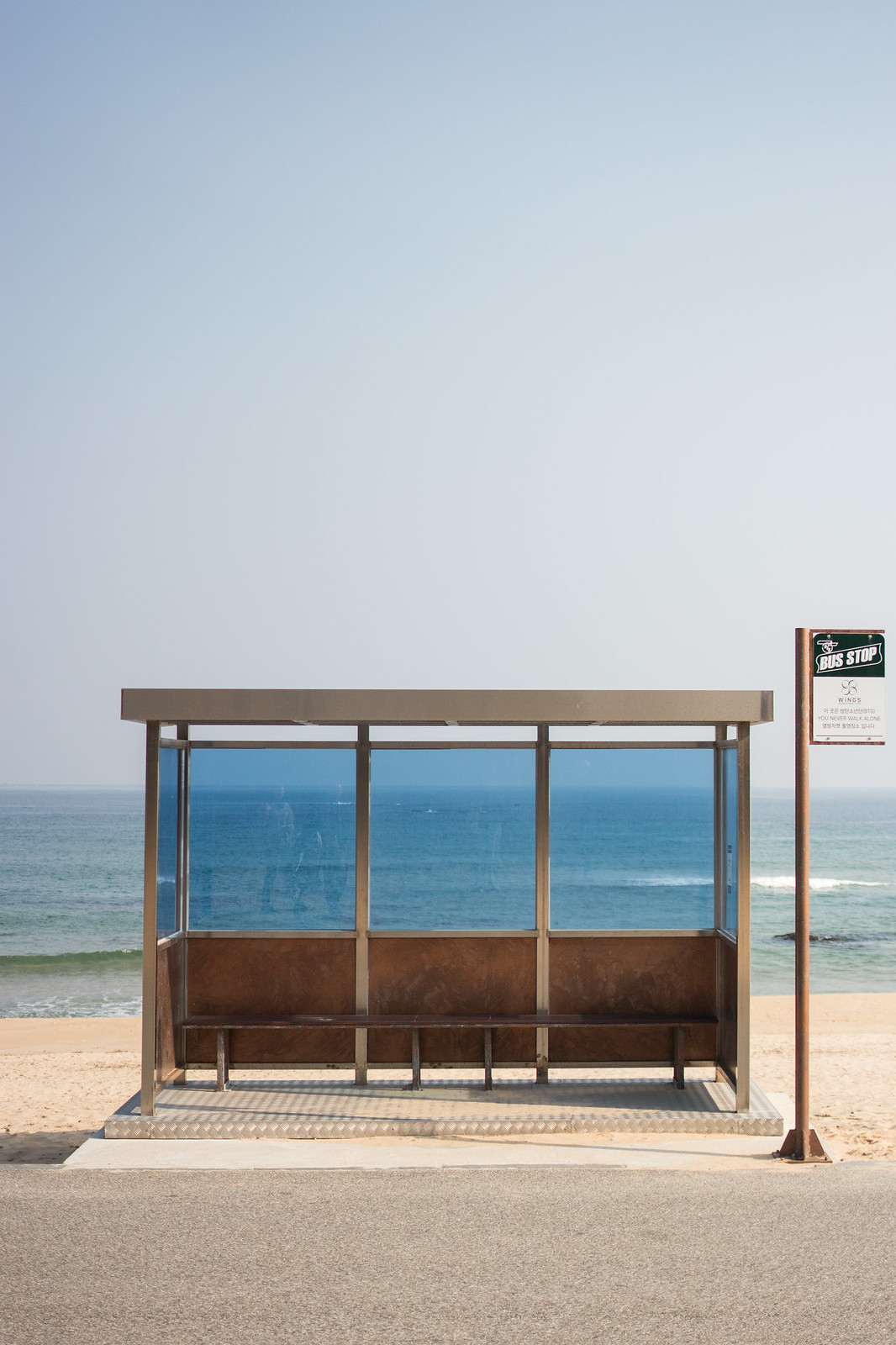
 While we were there, we also took a mandatory shot at the BTS Bus Stop (not an ARMY, but I have been listening to their music since I started listening to kpop).
 Our next stop, Jumunjin Breakwater, was a tricky one to get to from Jumunjin Beach due to the odd intervals bus arrival times. Eventually, we gave up waiting for the bus and took one hour on foot to arrive at the breakwater. It was a decision we half-regretted – the walk along the coast was soothing initially until our weak bodies started to feel the physical toll.
 When we reached, I picked the most decent looking restaurant (called Lobstar) on the spot and entered. From the second level of the restaurant, there was a clear view of the several breakwaters extending out into the aquamarine sea. This included the specific breakwater that appeared in drama Goblin – it’s easily identifiable with a line of people waiting to snap some photos there.